25 September 2012

Albalablanch 1


As a tower, Albalablanch is something of a monstruousity, an architectural marvel and a maintenance nightmare. Its sheer size would offer ample space for its population on one level only. Yet, Albalablanch has a recorded seventy of them, spread over a height of some twenty kilometres.

It would be wrong to infer that each level is separated from the one above by approximately 330 meters. The average height is of little significance here. While some levels, particularly the middle ones, can have up to three kilometres of sky, good-sized hills and deep lakes as well as meteorological phenomenons, other levels, specially the lower ones, form a mere system of caves, some so low that the population living there has to stoop. An ideal place for a prison, would you think, and you couldn't be more wrong. For reasons specific to Albalablanch the prison has been set up on the highest level, with its innumerable trapholes and its open roof.

But enough on this topic. Everything in good time. We will come back on the social configuration of the tower. This fascinating subject will unveil as we proceed with our story. As for now, let's stick to figures : twenty kilometres high, seventy levels (more than half of which underground for the tower only rises fifteen kilometres above the desert). Its walls are so thick that they shelter their own indigenous population - a population with a bad reputation, not so much because it lives in the margins (Albalablanch has many different margins which are a constant threat to the cohesion of the middle class) than because it is the only one with - limited - access to the truth.

The maintenance of its walls should really be everybody's concern. But for most of us, sharing a responsibility means that this responsibility is not ours. As a result, after millennia of existence, the walls of Albalablanch have grown into a weird compound prone to geological accidents and reshuffling, helped by the fact that, fifteen kilometres above ground, the climatic conditions are widely different from the warm stable environment of its lowest caves. The stress induced on the fabric of the tower is considerable. It releases here and there in thundering cracks, causing in the population closest to its walls epidemics of deafness. This in turn is often used as an excuse by the person who doesn't want to entertain social conversation : a couple of shouted "WHAT ?" and a pointing at one's ears stop any inquiry. "He was probably thunderstruck", people whisper, shrugging. And they leave you in peace : being thunderstruck means that you live close to the walls and that, therefore, you will most likely turn out to be some sort of weirdo.

21 September 2012

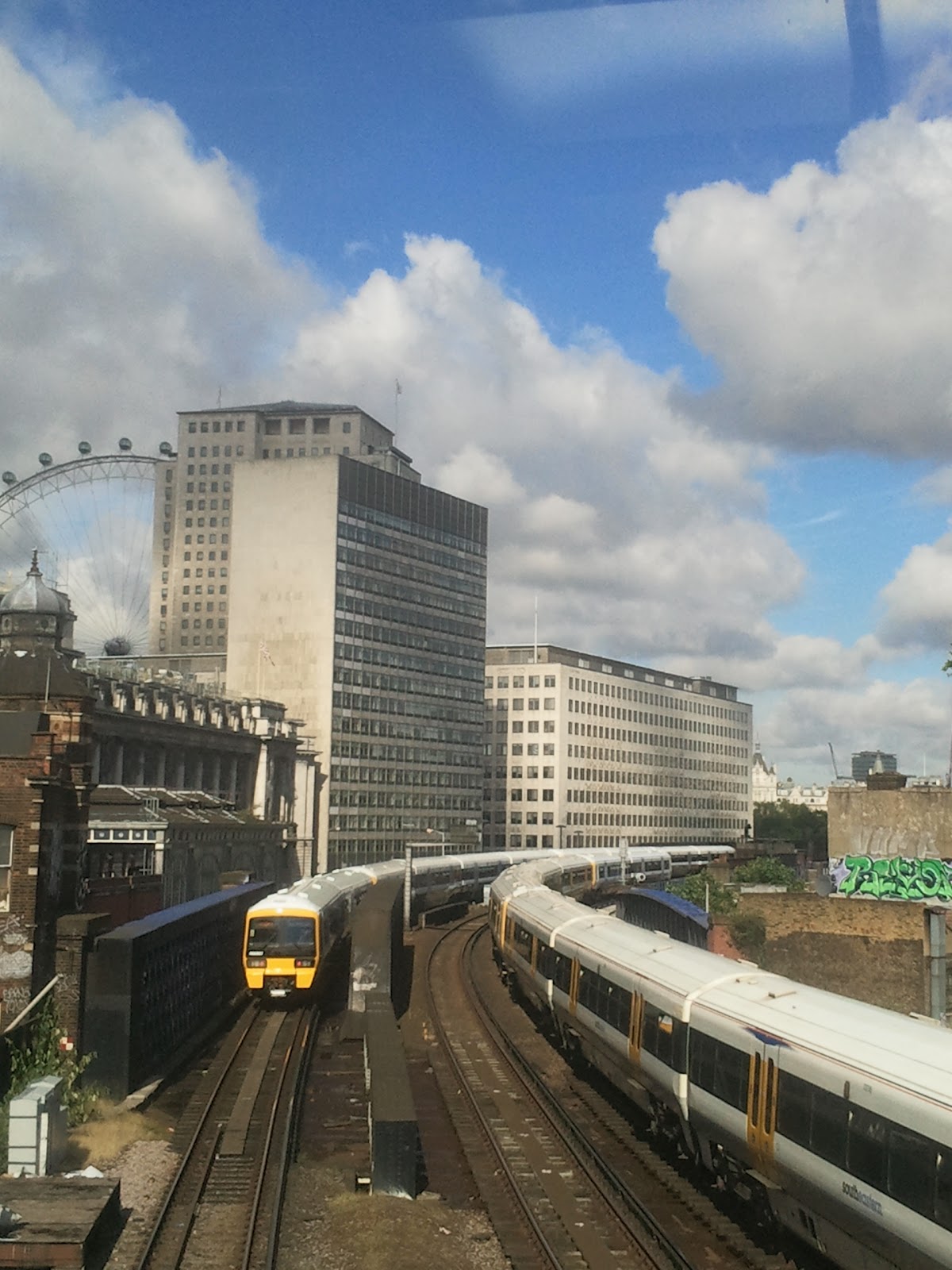
Why I prefer London to Paris - Reason 3

On rainy days London sails by
Ship of iron and stone
Hooked to the clouds by Wharf and Shard
Soaked to the last of its rats bone.

I pass a bridge wide as a deck
Choked by winds at war
London wobbles, this drunken wreck !
Its empty streets ajar.

20 September 2012

Hypnopompicture 10

Sun and rain
Mere stain
On a still sleeping mind
Deaf and blind
Cannot find
Their way to an escaping train


Albalablanch 0


Albalablanch is a good fourty kilometers wide. It is a respectable size for a town. It is a monstruous size for a tower. It is a tad narrow for a universe.

As a town it has everything one would expect: prisons, police stations, morgues, cemeteries, crematoriums, plus all the industries gravitating around the business of death, violent or not (non violent deaths have been recently reported on the increase): weapon factories and shops, fast transportation, cigarettes, alcohol, a few drugs, hospitals. Unexpectedly, given its particular shape and situation, Albalablanch also has the kind of old, heavy infrastructure which takes a toll in the tens of thousands every time it collapses - and it collapses every other week.

Of course it has all the amenities to produce and care for death's main ingredient: life. Hence a substantial human population -around thirty million as I write-, profusion of cattle on the top levels, fields in the lower levels (the natural weather being so unreliable), schools and offices (whose main purpose is to provide  favourable ground for mating), maternity wards and nurseries.

Albalablanch even has these little facilities humans are so fond of: clothes shops, food shops, houses and flats, hotels (entirely dedicated to business or sex and at their most succcessfull when combining both), places where humans can indulge in their bodily needs: bars and museums to keep the brain busy, sex-shops and prostitutes for a quick and easy fuck, millions of toilets to satisfy the pleasure of emptying their bowels, Churches, Mosques, Temples and Synagogues for the few remaining souls.

In short, Albalablanch could be described as a vibrant city by an outside observer, were there an outside left to observe it from.

31 August 2012

On modern gods

"Whoever starts from economy as a non deductible fact, initial cause of everything and unique reality which cannot be questioned, transforms economy into its own product, in a thing, makes it an autonomous historical factor and falls into economy fetishism."

Karel Kosík, die Dialektik des Konkreten, Frankfurt, 1967, quoted in HR Jauss, Pour Une Esthétique de la réception, Gallimard Tel, Paris, 1978
(1974), p. 35 (my translation)

12 July 2012

Hypnopompicture 9


Standards of Summer !
The Earth shakes under the Sun
Worms, snakes scrape its
Hot burned moist skin
And the rusted glories of man
Rise into the sky

18 June 2012

Hypnopompicture 8


Summer anger / anger summer
Colours cut like shadows
The dark sharp blade of shadows


14 June 2012

I wake up on a perfectly normal day.


I get ready for work. I walk out of the house to the train station. My head starts listing down what needs to be done, who needs to be called, which paperwork needs scribbling and sending, which problems need addressing and among all this, what I can reasonably expect to do on the day. I start choosing - tasks, ideas, budget, products, colours, materials, providers.

Suddenly life overwhelms me - stronger than me, it uses me as a tool. The me that says I is seized by this feeling : there are fewer and fewer chinks in my life. I am living inside them.

And literature comes to the rescue. How many times has it done that now ? Again this morning : in an essay published in 1954, Jean-Pierre Richard dissects Flaubert's mind through his writing:
"Et s’il est en effet un choix de Flaubert, c’est le choix de ne pas choisir, ou, plus négativement encore, le refus de la vie dans la mesure où elle oblige à se choisir. Mais ce refus engage Flaubert dans une très authentique expérience de la liberté ; l’être y vit dans l’impossibilité de jamais adhérer à lui-même. Pouvant être tout, il n’est rien. « Pas plus là-dessus que sur la question principale je n’ai d’opinion à moi » écrit-il lorsqu’on lui propose de publier des extraits de Saint Antoine. « Je ne sais que penser, je suis comme l’âne de Buridan… Voilà que, dans la question la plus importante peut-être d’une vie d’artiste…, je m’annule, je me fonds, et sans efforts hélas ! car je fais tout ce que je peux pour avoir un avis quelconque –et j’en suis dénué autant que possible… Je me déciderais à pile ou face et je n’aurais pas de regret du choix quel qu’il fût » (Flaubert, Correspondance, II, p : 320)  (1)"

"And if indeed there is a choice from Flaubert, it is the choice of not choosing, or, even more negatively, the refusal of life in the sense that life forces us to choose. But this refusal involves Flaubert in a very authentic experience of freedom; the being living in it cannot possibly ever adhere to himself. Because he can be everything, he is nothing. “On this as well as on the main question, I have no personal opinion” Flaubert writes when offered to publish extracts of The Temptation of St Antoine. “I know not what to think, I am like Buridan’s ass... Suddenly, in what may be the most important question in the life of an artist..., I offset myself, I melt, and effortlessly alas ! for I do whatever I can to have an opinion, any opinion –and I am as opinionless as it is possible to be... I would flip a coin to decide and I would have no regret about the choice, whichever it might be.” "  (1)
Dilution is a feeling. It is a state of the being. It is a problem. I create and tell stories in an attempt to make sense of my own life. But who needs it ? There is no need for sense in order to survive. There is no need for consistency. There is no need for choice. There is only the need for food.

So then, what should I have for lunch ?


============
(1) Jean-Pierre Richard, Littérature et Sensation, Seuil, 1954, p : 193 (my translation)

28 April 2012

Why I prefer London to Paris - Reason 2

Nunhead Cemetery, up the hill
Flowers open from the graves
On my bike, through the rain
I take in their fragrance
Mixed with flesh decomposed
Like the whiff of an island,
Cold, from the Caribbeans

20 April 2012

Why I prefer London to Paris - Reason 1

I stop and watch big barges sail up the Thames from the estuary.
Their wake is brown with silt.
Seagulls follow them; they fly over the City.
I can hear them shriek.

19 April 2012

The Book Sill - The City and the City 2

The City and The City however makes no attempt at hammering any truth. It is not a parable. If anything, it works as a metaphor of itself.

For Borlù, truth comes as a revelation, the removing of a veil: there is a before, there is an after. As Rousseau-like as this might sound, there is a fondamental difference between Mieville's novel and La Nouvelle Héloïse. For Rousseau, there are degrees in revelations. The first revelation denounces the subjectivity of mistakes. It shows the face of the statue behind the veil. But it does not propose anything to replace the illusion it destroys. The reality this first revelation highlights is nothing but another subjectivity. The face so suddenly exposed does not have more to do with some objectivity of the world. "Things", "objects", "facts", whichever word we might use to designate what is not us, are nothing more than a framework on which we base our vision. It does not matter which degree of lucidity we think we reach, this first degree revelation only peals another layer of an illusion which seems to have no core.

Mieville does not go further than this. To go further would be, like Rousseau did, to dive into the inner being, to open to this being, to enjoy its immediacy as a truth. The doxa of twenty-first century Europe, to which Mieville belongs, goes against the mysticism of a Rousseau. We fought -we are still fighting- to get rid off it. There is no truth. There cannot be any truth. There is just the Pealing -and then death.

From this basis, Mieville draws a fascinating picture. Since there is no truth, since there is only the endless pealing of illusion, then everything we know for certain is a mere understanding of the world (this is much more in line with the Zeitgeist). This understanding, in turn, shapes our perception. To us the world is like these pictures which can be seen two ways (a vase or two profiles looking at each other; a landscape or the face of an old man): it is almost impossible to see both at the same time. Our brain seems to allow one and block the other, as if there was a one-way switch to it. Here I am reminded of Pratchett's idea of belief and how most people cannot see what they do not accept: only a handful of "happy few" can see the Gods, or Death, all entities created by human faith and roaming around us. The rest of us is blind to anything we think unacceptable.

The story of The City and the City is this: a man, brought up to "unsee", learns to de-unsee. Some event in his life forces him to unveil the statue and look into its grinning face. But what is the meaning of this face? What is the meaning of the world suddenly jumping to Borlù's eyes? Mieville's story does not answer this. Its ultimate conclusion is that, once the veil has been lifted, once the light we shed on the world has changed, it is impossible for us to come back to what we were.

And this is where The City and the City works as a metaphor of itself: once you close the book after reading the last page (2), you start looking for what you usually unsee -what you have been taught to ignore, to believe to be impossible, non-existant, meaningless, albeit being in front of your eyes. It takes humility to undertake such a task. More importantly, it takes courage. For there is one thing to say about the kind of enlightenment Borlù goes through: it isolates and it hurts.

--------
(1) See Jean Starobinski, Jean-Jacques Rousseau, la transparence et l'obstacle, Gallimard, Tel, Ch IV, 1971, p.92
(2) A friend recently told me that she had contracted the habit of not finishing the books she reads. "Nowadays I tend to stop reading a book ten or twenty pages from the end. I've always found the endings pointless anyway. What's really interesting is the build-up. After that it's always the same story".

Ah, why Eric, why...

I love Eric Chevillard (see L'Autofictif in the links on the right-hand side of this blog) (well, if you can't read French, I can't help it). His daily posts are like praline chocolates, the taste of which stays with you for an hour or two and makes the world a warmer place. Today, however, this delicate and funny writer committed the unforgivable.

"Il était rare que nous entendions le son de sa voix", says his post number 1554, thus failing to use the rarer and more proper imperfect subjunctive "Il était rare que nous entendissions [...]".

This, for you English readers, is nothing, is snobbery. This, for me, is the equivalent of walking on a quiet beach at dawn, spotting a green, thin, fragile, translucent little eggshell rested there on the sand, tiny miracle laid down by the mighty hands of the tide, and deciding to stamp on it.

Lucky you are, barbarians, to be blind to this treasure, and ignorant of its annihilation.

12 April 2012

The Book Sill - The City and the City

Mieville's universes are mutilated. The Scar and Perdido Street Station are stories of a wounded world. The City and the City is the story of a town cut in two.


Mieville has also a taste for realism, or so it seems. His characters are all dealing with every day needs. Feed, drink, fuck, sleep. Bad days at work. Inner dilemmas, fear, cowardice. Confusion. Betrayal. Unrewarded heroism. Decisions made in a state of emergency, with incomplete information. Mistakes. Angers and frustrations. However strange, his eras are always our times, his places somehow our world.


Beyond this realism, Mieville writes cross genre novels. Perdido Street Station was a mixture of steampunk, fantastic and anticipation. The City and the City is a detective novel as well as a dystopia, set in alternative history. The detective novel of our times, some say, is like the knight romance of the 12th century: it embodies the quest for the truth. 900 years ago, to find it one could only follow the hidden path marked for him by God and overcome Its tests. Today one can only sets to solve a mystery for which there are too few clues.


In The City and the City Mieville's hero Borlù finds little truth. Together with him we learn that a young student got killed for seeking the truth. That the taboo organising life in the twin cities of Beszel and Ul Qoma is carefully maintained by some hidden power calling itself Breach. That Breach is breaching everyday in order to keep the taboo safe and going. But how did this taboo come into existence, how it manages to survive the modern world with its open access to information, what real benefits are gained from this situation, all this is hardly developed.


The City and the City might be Mieville's shortest novel so far. It is also a novel of little content. The characters are overall quite forgettable. Borlù reminds me of Pepe Carvalho in that he seems to sink into hopelessness and depression as he progresses in his inquiry. His findings lead him nowhere: there is nothing he can do to bring the culprits to court. The plot is a known mix of solving crime, exposing social backgrounds and unveiling political conspiracies. The fictional geo-politico-strategical net built by Mieville could be inspired by many situations: today's Jerusalem, Berlin in the 70's, current Koreas or even any modern city where rich and poor populations seem to live side by side and ignore each other's presence.


In The City and the City, Mieville has little to say to us that we do not already know. Actually he has only one thing to say: we might be able to sew back together what was once mutilated, but that mending, that accession to a more complete life, will not restore any ancient order. It will set us apart, apart from the people we know, apart from our old self, our past. This however, Mieville says with such a force that the story stays in the mind like a parable; it changes the way we look at our own world.

28 March 2012

The Priest Cat

"My Lord,
Every day, every minute of my life I have served You. I have never doubted. In all my life I have followed Your law. In return, You have answered my prayers.
Today I implore You, in Your kindness, to spare young Joe Abbott. His family is poor. He is their only consolation.
Of course his father Tim drinks a bit too much, a bit too often. He gets angry when he does so but that is only the addiction talking. He is a slave, my Lord, a slave of alcohol.
You always had a good ear for the slaves.
His mother Sophie believes in You. You know how few people truly believe in You. Sophie, like me, has never doubted. For her my Lord, for her, I implore You, spare the life of her young son. Spare the life of Joe Abbott".

The priest was kneeling in his bedroom. He should not have been praying here. He should have gone to the Lord's house, the adjacent church. But this was the core of winter, the church was freezing and dark. There was no money to pay for the heating. There was no money to pay for the light. There was not even enough money to replace the candles.

Where he was praying, he kept telling himself, did not really matter. He knew that if he prayed from the bottom of a pure heart, the Lord would hear him. Besides, his bedroom was a decent place. From the praying chair he looked around him.

With its walls painted in a uniform brown, its dark stone floor, its unique window, the bedroom was monastic. The only luxury was a small wooden bedside table, his share of their mother's inheritance. He had covered the fine marquetry with a long, pale green cotton cloth. On it was a boxwood sprig and a silver dish of holy water which surface was shivering softly.

The bedroom rested in complete silence, the sound of the main road muffled by the distance and the almost closed window. A mural lamp, its glass shade deafened with a dark cloth, provided a weak gleam, leaving most of the room in the dark.

This, he felt, was appropriate for prayer. This... bareness, this nakedness, this soft silence. There was nothing to distract him from his own thoughts, all turned towards the Lord. Sometimes, on nights like this, he could feel His breath entering the room.

There was a scratching noise behind him. The cat was getting hungry. This spoiled the serenity of the moment. Why did the animal always have to be hungry at the wrong moment, right now, during his evening prayers? With the day over, his poor and sick all in bed, any preparation for the mass done, his mind was at peace, his soul rested and unhindered, this was the best moment. His prayers were always the purest and the strongest at night.

He had had the cat for many years. It used to belong to his sister. One day, just after leaving her husband, she had brought it to the priory. "This is only temporary", she had said. "I am between houses at the moment, I can't carry her around, the poor thing is stressed enough as it is. Can you keep her for a few weeks? I'll have her back as soon as I can."

She never came back. A few weeks later she had met a man from Rio, fallen in love, left her job and taken the first plane for Brazil where she had "started on a new life". "What new life?" he thought. "The Lord gives us one life. Only one. No matter how often it breaks, how often we mend it, it is always the same life."

He didn't approve of her sister. For what he knew of them, he didn't approve of Brazilians either. He didn't approve of divorces, or pets. They were nothing but self-indulgence and distraction.

He hadn't seen her in twelve years. The cat was getting old. So was he. Soon it would die.

The scratching noise came back, a bit louder, a bit longer. The priest sighed. Was it only him, or did all this scratching start a bit earlier every day too? The quicker he responded, the more he gave it, the greedier the animal became. It seemed insatiable.

"Perhaps I should just wait. Let it scratch. Feed it every day at exactly the same time and ignore its little theatre. Perhaps that would teach it discipline."

But he could not pray with the scratching noise. There was no way around it: for the sake of young Joe Abbott, he had to feed the beast.

The priest winced as he stood up. His joints were hurting. This was why he prayed from home these days. Poor empty churches were no good for arthritis. He started towards the kitchen, his walk heavy with age, his feet dragging a bit, the thick rubber sole of his black shoes snapping on the floor joints. He hoped he had a tin left of that chicken liver cat food the grocer gave him. If not, the cat and him would have to share his diner: two slices of cured ham, some beans and a salad. Neither of them could digest bread any more.

As he was opening the tin, the thought of Joe Abbott caught up with him. What a nice kid he was. It had pained the priest, tonight, to see his poor, ten-year-old body sink into sickness, his tanned, smooth skin getting pale and gritty, his thick slick black shiny hair becoming thin and dry like withered weed. Joe had not been able to get up. Tuberculosis was ripping his chest, fever was shaking his body and putting a constant wet brightness  in his black eyes. Young Joe was looking somewhere else already, seeing other things. He had become a ghost even for his mother. She looked so scared all the time, so vulnerable. She couldn't eat. She was so thin, as if about to snap.

The cat was rubbing madly against his leg: "Yeah yeah yeah, it's coming you old fool. Covering my trousers with your hair will never bring it quicker, you know. Don't you know that? Don't you learn anything?"

"Talking to it doesn't make any difference either", he thought, as he was walking back to his bedroom. "The cat doesn't understand me. Or does not believe me."

He played for a moment with this idea. "Maybe it knows, after all. Maybe rubbing itself against my leg makes it feel good. Maybe it knows how annoying I find it and does it for that precise reason."

They had been living with each other for all these years, and yet they could not possibly understand each other. "We are just living side my side", he thought, "each of us isolated in our own perception of the world."

Such was the way of life. Take young Abbot: he was watching him wither, fade from this world, step into the other. "I am a priest, I am supposed to know about all this, about death, the transition of death, life after death. Yet I cannot, not one single second, understand what he is going through."

There was no communicating, with anybody, but the Lord. There was only prayer. Prayer worked. He had seen evidence of it, repeatedly. How many times had he prayed for the sick and seen then rise again? Ten times maybe, maybe more?

When the telephone rang ten minutes later, the priest had returned to his duties. His body was arched against the kneeling chair, his heavy breathing covering any other noise in the bedroom. The ring startled him. He got up, walked around the bed, picked the receiver. He sat heavily on the bed, letting all his body go. He brought the receiver to his hear, knowing already.

Tim Abbott's voice was drowned in tears. He was calling to inform the priest that his son had passed away.

As the priest hung up, the cat started scratching again. Its food bowl was empty. It was looking at the priest. There was expectation in its eyes.

The priest picked it in his arms, opened the back door and put it gently outside.

The cat jumped on the window sill and started waiting.

20 March 2012

The Metro Crush

As a nation we are
Drinking 143 million fewer pints of beer
Smoking 51 million fewer cigarettes
Eating 75 million fewer takeaways 
Every month
One in 11 people is turning vegetarian to save on the weekly shop after meat prices rose by 5.7 per cent last year.

As a nation we are also
Dodging 25% of our rounds at the pub
Leaving 0% tips at restaurants
And giving up 100% of our donations to charity

The Law - aka Survival of the Fittest
Mother of Liberalism
Father of the Holy Crush
Mother of the Law

08 March 2012

Hypnopompicture 6

Spring is out
He tells me
Big white bricks of sheet
And the sky
Almost as bright as light


23 February 2012

Hypnopompicture 5 - Orbitor

Who sits here and sleeps
Who lies there and speaks
Your life is upside down between
The city and the city

16 February 2012

Hypnopompicture 4

And so Spring begins
Cold fever on a feeble day
Saffron azure


15 February 2012

Roaming


No pilot on these boats; no
Captain; no staff; everyone aboard
Is from somewhere else.


The shopkeeper is from Shropshire
The cockney cook has a West Ham tattoo
Under his shirt
And St Jack crosses on his cufflinks
The mechanics speak to each other in Polish
I once spoke Polish with Frédéric Chopin's great grand nephew in Narita airport
We were drinking jasmine tea thence
The cleaning ladies are from Antwerp
They smile at me as if
I was family
The young man who works the till, at the self service restaurant
Has a golden brace with his name on it
Robert
He tells me he lives in Dover.

From his bedroom window
He watches the boats cross the dark stones of the port jetties
He was born in a nearby hospital, eighteen years ago.
He has never travelled further than Calais
He has never been to Calais
From the deck, four times a day, he sees its yellow sanded beach
Then he turns around and goes home.
He is the closest the boat has to an owner.

The boat slips, on its invisible thread, across the channel
The owner hands me the bill
Five pounds eighty and a free coffee.


09 February 2012

Hypnopompicture 3


The poles, all the spikes
Can't you see the sky?
The crispy crystalline crust of the sky

Can't you see it crack?


And through the riff 
All the waters pour

The blue waters that surround the world